🚩 HTB Sherlock - RemoteAccessRegret
Executive Summary
- Scenario: On February 18, 2025, Margaret was browsing the web for Thanksgiving recipes when her browser displayed a full-screen warning claiming her computer was infected. She called the phone number on the screen, a man posing as “Microsoft Support” convinced her to install a remote-access tool, spent over an hour “cleaning” her computer, and then pressured her into paying $500 in gift cards. As a DFIR analyst our job is to analyse the Chrome browser data and AnyDesk application data to reconstruct the tech-support scam.
- Status:
Completed
Collection
The challenge files live on the provided VM at /home/analyst/Desktop/ChallengeFile/RemoteAccessRegret.zip. We create an extracted/ and an artifacts/ working folder next to it, and extract the archive with the given password hacktheblue. We are left with a single file, intelvol.raw. Just like normal, we check what kind of file we are dealing with:
unzip -P hacktheblue RemoteAccessRegret.zip -d extracted && cd extracted && file intelvol.raw
It is a 128 MB FAT16 volume labelled INTELVOL. There is no partition table, it is a bare filesystem, so every (incomplete) The Sleuth Kit command we run uses offset 0.
Examination
To see the layout without mounting anything, we walk the filesystem recursively with fls:
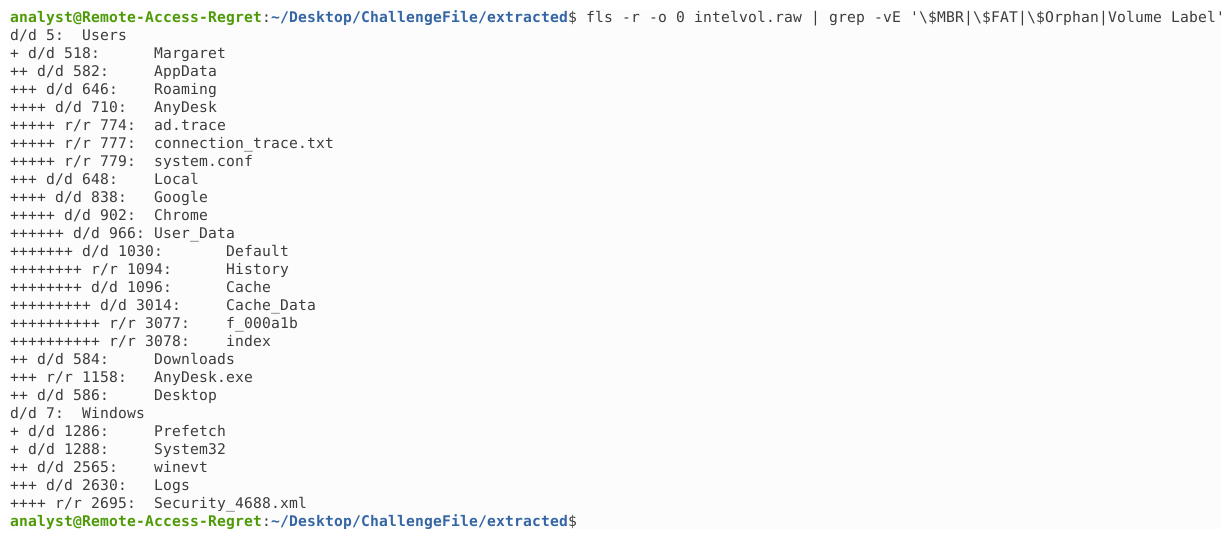
The volume is a neatly curated set of exactly the artefacts the scenario promised:
- AnyDesk (
AppData\Roaming\AnyDesk):ad.trace,connection_trace.txt,system.conf - Chrome (
AppData\Local\Google\Chrome\User_Data\Default):History(SQLite), plus theCachewithf_000a1b - Downloads:
AnyDesk.exe - Windows event log:
Security_4688.xml(process creation)
Rather than mounting the image, we carve each file out by its inode with icat -o 0 intelvol.raw <inode> > <file> into the artifacts/ folder, and do the rest of the analysis against those copies:
for f in 774:ad.trace 777:connection_trace.txt 779:system.conf 1094:History 3077:f_000a1b 3078:cache_index 1158:AnyDesk.exe 2695:Security_4688.xml; do icat -o 0 intelvol.raw ${f%%:*} > ../artifacts/${f#*:}; done; cd ../artifacts && ls -la
Note: The VM doesn’t come with The Sleuth Kit or
sqlite3, and it has no internet access. I downloaded the Ubuntu 20.04.debpackages on my own machine, copied them over withscpand installed them withsudo dpkg -i.
Analysis - Questions
What is the local AnyDesk ID assigned to the victim’s computer?
Every AnyDesk install stores its own ID in system.conf under [client], and it is also announced in the trace log at startup. Both agree:

Answer: 847291503
Using the Chrome History database, what was the first website Margaret visited before encountering the scam?
We query the urls table, converting Chrome’s WebKit timestamp (microseconds since 1601) to a readable time, and sort ascending to find the very first entry:

The earliest row is Margaret’s Google search for Thanksgiving recipes, the first site she loaded that day.
Answer: www.google.com
What is the domain of the initial malicious redirect that led Margaret to the scam page?
Filtering the history for the scareware-related entries shows two hostile URLs. The first one, the redirect that kicked off the scam before the fake Defender page loaded, is a classic parked-ad “windows-security-alert” domain. Note the tid=8847291 parameter, it matches the Support ID printed on the scam page later:

Answer: ww1.windows-security-alert.com
The scam page was cached by Chrome. Examining the cached HTML file, what phone number was displayed to the victim?
Chrome kept a copy of the fake alert page in its cache as f_000a1b. Grepping the cached HTML for a phone pattern pulls out the number the victim was told to call:

Answer: +1 (888) 351-4019
What is the AnyDesk ID of the remote machine that connected to Margaret’s computer?
The AnyDesk trace log records the incoming session request along with the remote peer’s ID:

Answer: 529481627
What alias did the scammer use for their AnyDesk connection?
Right after the remote ID, the trace logs the alias the peer presented, and connection_trace.txt repeats it, a deliberately reassuring MicrosoftSupport:

Answer: MicrosoftSupport
According to the AnyDesk logs, what was the total session duration in seconds?
When the session closes, AnyDesk writes the duration in seconds directly to the trace, and connection_trace.txt corroborates it with the 01:07:32 wall-clock time:

01:07:32 is exactly 4052 seconds, over an hour of hands-on-keyboard access, matching the scenario.
Answer: 4052
The AnyDesk logs show files were exfiltrated. What is the filename (not full path) of the first file stolen from Margaret’s Desktop?
The trace records every file the remote operator uploaded off the machine. Three documents were taken; the first one that came from the Desktop was her bank statements (the Tax Return was pulled from Documents):
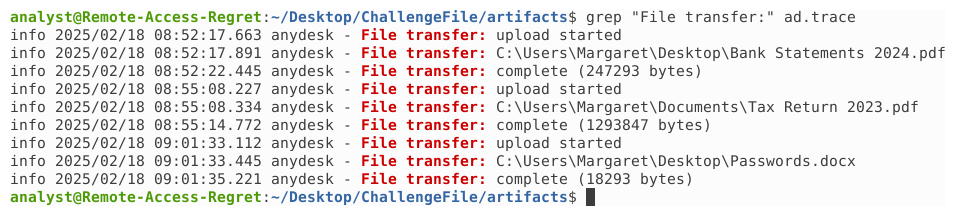
Answer: Bank Statements 2024.pdf
How many bytes total were uploaded (exfiltrated) to the remote attacker during the session?
At session close AnyDesk logs the running total of uploaded bytes, and connection_trace.txt reports the same figure as Transfer Out:

Answer: 1559433
Based on the Chrome History, how many total URLs were visited during the browsing session on the day of the incident?
A simple count of the urls table gives the size of the whole browsing session, from the recipe search through the scam pages, the AnyDesk download, the banking login, and finally the Target gift-card page:

Answer: 10
References: Link